+86-577-61777758 info@hosetrading.com
Request a Quote 
How to Evaluate Abrasion Resistance, Impact Strength, Low-Temperature Performance, and Long-Term Durability?
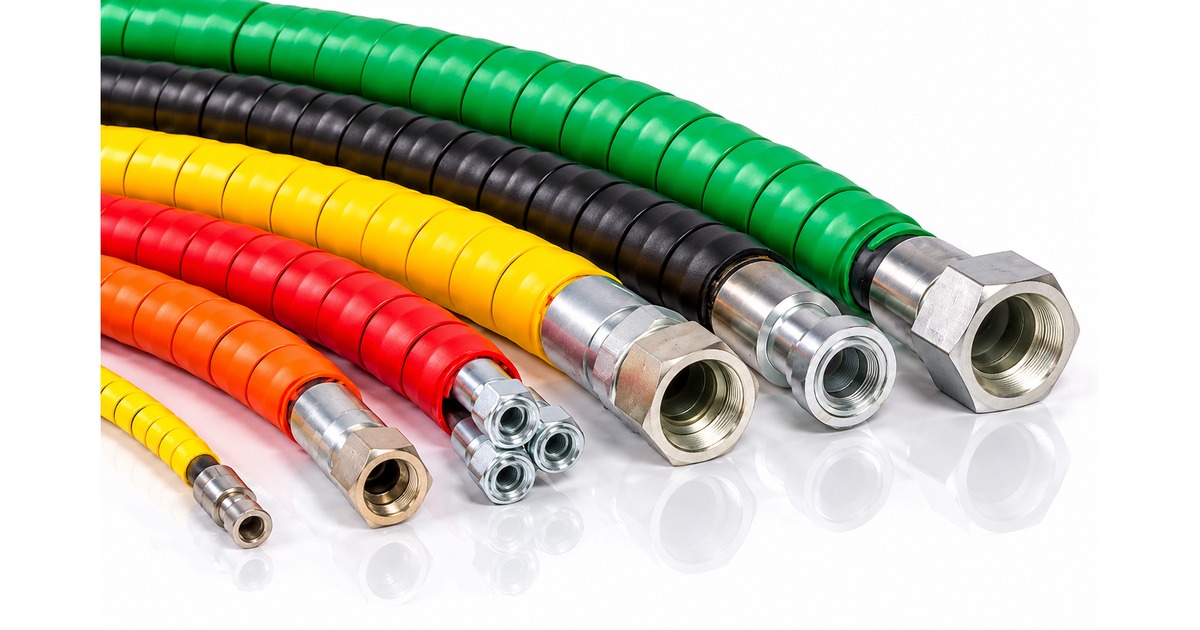
Spiral Guards play a critical role in protecting hydraulic hoses from abrasion, impact, crushing, and other forms of mechanical damage in demanding operating environments.
Typically made from polypropylene (PP), spiral guards are widely used in construction equipment, agricultural machinery, mining equipment, and industrial hydraulic systems.
But choosing a high-quality spiral guard involves more than simply looking at the raw material. Actual performance depends on several factors, including material properties, spiral design, wall thickness, installation conditions, and exposure to the elements.
For manufacturers, hydraulic hose suppliers, and OEM purchasing engineers, the following eight performance tests provide a practical framework for evaluating the quality, durability, and reliability of spiral guards.
1. Abrasion Resistance Test
Recommended Priority: Critical
Abrasion resistance is one of the most important performance characteristics of a spiral guard.
During equipment operation, hydraulic hoses can rub against metal brackets, machine frames, adjacent hoses, and other surrounding components. Over time, continuous friction can wear down the protective sleeve and eventually expose the hose underneath.
Recommended Test Procedure
1. Install the spiral guard onto a specified hydraulic hose.
2. Secure the hose assembly in a dedicated abrasion-testing fixture.
3. Apply controlled contact pressure against a defined abrasive surface.
4. Run repeated reciprocating friction cycles at a specified speed and stroke length.
5. Record the number of cycles, wear depth, and material loss.
6. Inspect the spiral guard for cracks, breakage, and complete wear-through.
Key Performance Indicators
a. Number of abrasion cycles before failure
b. Weight loss (mg or g)
c. Wear depth (mm)
d. Surface damage and cracking
e. Whether the underlying hydraulic hose becomes exposed
Engineering Recommendation
Develop a standardized abrasion test for the finished product that reflects actual operating conditions.
Keep key testing parameters—including contact pressure, abrasive material, friction speed, and stroke length—consistent to ensure repeatable and comparable results.
For OEM applications, testing the spiral guard installed on an actual hydraulic hose provides more meaningful performance data than testing raw PP material alone.
2. Compression Resistance Test
Recommended Priority: Critical
Hydraulic hoses installed on construction equipment are often exposed to external pressure, accidental impacts, and contact with surrounding machine components.
A high-quality spiral guard should provide additional mechanical protection without cracking or permanently losing its protective shape.
Recommended Test Procedure
1. Install the spiral guard onto a hydraulic hose with a specified outside diameter.
2. Position the hose assembly in a compression-testing machine.
3. Gradually increase the compressive load.
4. Measure the deformation under the applied load.
5. Release the load and measure how well the spiral guard recovers its original shape.
6. Inspect the product for cracks, fractures, and permanent deformation.
Key Performance Indicators
a. Maximum compression load (N)
b. Maximum deformation (mm)
c. Permanent deformation after unloading
d. Recovery rate (%)
e. Visible cracking or structural failure
Engineering Recommendation
Evaluate both the spiral guard and the complete hose assembly.
A protective sleeve that maintains its shape after compression can help reduce the risk of direct external damage to the hydraulic hose.
Test loads and acceptance criteria should be established based on the product design and the OEM customer's requirements.
3. Impact Resistance Test
Recommended Priority: High
Impact resistance measures a spiral guard's ability to withstand sudden mechanical impacts.
In construction and industrial environments, hydraulic hoses may be exposed to flying debris, falling tools, accidental collisions, and contact with nearby machine components.
If impact resistance is inadequate, the spiral guard may crack or break, compromising its ability to protect the hose.
Recommended Test Standards
ISO 179-1: Charpy impact properties
ISO 180: Izod impact properties
These standards are commonly used to evaluate the impact resistance of plastic materials.
Recommended Test Conditions
Impact testing at room temperature
Low-temperature impact testing at -20°C
Low-temperature impact testing at -30°C
Key Performance Indicators
a. Impact strength (kJ/m²)
b. Energy absorbed during impact
c. Crack formation
d. Brittle fracture
e. Structural integrity after impact
Engineering Recommendation
Standard Charpy and Izod tests are performed on prepared plastic specimens, not on complete spiral guards.
For a more realistic assessment, manufacturers should also consider drop-weight or controlled-energy impact testing on the finished spiral guard installed over a hydraulic hose.
This approach provides a better indication of how the actual product performs under mechanical impact.
4. Low-Temperature Resistance Test
Recommended Priority: High
Low-temperature performance is particularly important for spiral guards used in North America and other cold-weather markets.
Depending on its grade, formulation, and impact modification, polypropylene can become more brittle at lower temperatures.
A spiral guard that performs well at room temperature may crack during installation or operation in freezing conditions.
Recommended Test Temperatures
|
Test Temperature |
Evaluation Purpose |
|
-20°C |
General low-temperature screening |
|
-30°C |
Enhanced cold-weather performance |
|
-40°C |
Severe cold-weather applications |
Recommended Test Procedure
1. Place the finished spiral guard or prepared test specimens in a temperature-controlled chamber.
2. Condition the samples until they reach the specified test temperature.
3. Hold the samples at that temperature for a defined period.
4. Perform impact, bending, or installation-related tests under controlled low-temperature conditions.
5. Inspect the samples for cracking, splitting, and brittle fracture.
Key Performance Indicators
a. Resistance to brittle fracture
b. Crack formation during bending
c. Structural integrity during installation
d. Impact performance at low temperatures
Engineering Recommendation
For standard construction equipment applications, -30°C is a useful starting point for product development.
For heavy-duty equipment operating in extremely cold climates, -40°C can be considered as an additional development target.
Final acceptance criteria should be established through product validation and customer specifications.
5. UV Weathering Resistance Test
Recommended Priority: High
Spiral guards used on outdoor construction equipment are regularly exposed to sunlight, temperature fluctuations, and changing weather conditions.
Prolonged ultraviolet (UV) exposure can degrade polymers, leading to surface cracking, discoloration, and a decline in mechanical properties.
Recommended Test Standard
ISO 4892-2: Plastics — Methods of Exposure to Laboratory Light Sources — Xenon-Arc Lamps
Xenon-arc weathering tests simulate important aspects of outdoor sunlight exposure under controlled laboratory conditions.
Recommended Evaluation Items
Color changes before and after exposure
Surface cracking
Changes in tensile strength
Changes in impact strength
Abrasion resistance after weathering
Suggested Exposure Intervals
Manufacturers may evaluate samples at different exposure intervals, such as:
500 hours
1,000 hours
These are suggested product-development checkpoints, not universal acceptance requirements.
Engineering Recommendation
For black PP spiral guards, the quality, concentration, and dispersion of carbon black are important factors in determining UV resistance.
Appearance alone is not a reliable indicator of weathering performance.
A more effective approach is to conduct mechanical testing before and after UV exposure to determine whether the material retains its protective properties.
Note: Laboratory exposure hours cannot be directly translated into years of outdoor service life.
6. Chemical and Hydraulic Oil Resistance Test
Recommended Priority: High
Spiral guards are often used in environments where they may come into contact with hydraulic fluids, lubricating oils, cleaning agents, and other industrial chemicals.
Depending on the polymer formulation and the chemicals involved, exposure may cause dimensional changes, surface deterioration, or changes in mechanical properties.
Recommended Test Standard
ISO 175: Plastics — Methods of Test for the Determination of the Effects of Immersion in Liquid Chemicals
This standard provides a framework for evaluating how exposure to liquid chemicals affects plastic materials.
Recommended Test Media
Depending on the intended application, testing may include:
Mineral-based hydraulic oils
Anti-wear hydraulic oils
Synthetic hydraulic fluids
Industrial lubricants
Commonly used cleaning agents
Whenever possible, use the actual fluids specified by the customer.
Key Performance Indicators
|
Evaluation Item |
What to Check |
|
Weight change |
Weight gain or loss after immersion |
|
Dimensional change |
Swelling or shrinkage |
|
Surface condition |
Cracking, discoloration, or deterioration |
|
Impact strength |
Changes after exposure |
|
Tensile strength |
Changes after exposure |
Engineering Recommendation
Whenever possible, use the actual hydraulic fluid grades and operating temperatures specified by the customer.
For PP spiral guards, chemical compatibility should be evaluated using the actual material formulation rather than relying solely on general material compatibility charts.
Note: ISO 1817 is primarily intended for rubber materials. It should not be used as a direct substitute for ISO 175 when evaluating PP plastic products.
7. Flex Fatigue Test
Recommended Priority: High
Hydraulic hoses installed on construction equipment are constantly exposed to vibration, movement, and repeated bending during operation.
A spiral guard must maintain its structural integrity while allowing the hydraulic hose to flex normally.
Insufficient flexibility or fatigue resistance can lead to cracking, loosening, displacement, or damage to the hose surface.
Recommended Test Procedure
1. Install the spiral guard onto a specified hydraulic hose.
2. Set the hose assembly to a defined bending radius.
3. Perform repeated bending cycles under controlled conditions.
4. Monitor the movement and position of the spiral guard throughout the test.
5. Inspect the product for cracking, breakage, loosening, and displacement.
6. Check the hose surface for signs of abnormal wear.
Suggested Evaluation Intervals
10,000 cycles
50,000 cycles
100,000 cycles
These are suggested product-development checkpoints. The actual cycle count should be determined by the application and customer requirements.
Key Performance Indicators
a. Number of bending cycles completed
b. Cracking or fracture
c. Spiral guard displacement
d. Loss of retention
e. Damage to the underlying hose surface
Engineering Recommendation
Flex fatigue testing should be performed using the actual spiral guard installed on a representative hydraulic hose.
Pay close attention to the bending radius, hose outside diameter, spiral pitch, and installation fit.
These factors can significantly affect the performance of the complete hose protection assembly.
8. Flame Retardancy Test
Recommended Priority: Application-Dependent
Flame retardancy may be necessary for hydraulic hose protection products used in applications with specific fire safety requirements.
However, not every spiral guard needs a flame-retardant formulation.
For standard outdoor construction equipment, abrasion resistance, impact resistance, UV stability, and low-temperature performance are often more important initial development priorities.
For equipment operating near high-temperature components, in mining environments, or in applications subject to specific fire safety requirements, additional flame-retardancy testing may be necessary.
Common Test Standard
UL 94: Standard for Tests for Flammability of Plastic Materials for Parts in Devices and Appliances
Common classifications include:
|
Classification |
Description |
|
HB |
Horizontal burning classification |
|
V-2 |
Vertical burning classification |
|
V-1 |
More stringent vertical burning classification |
|
V-0 |
More stringent vertical burning classification |
The classification achieved depends on specimen thickness, material formulation, and the applicable test requirements.
Engineering Recommendation
For standard PP hydraulic hose spiral guards:
Start with a conventional abrasion-resistant PP formulation.
Confirm whether the OEM customer has specific flame-retardancy requirements.
Develop a flame-retardant PP grade only when the application calls for it.
Evaluate how flame-retardant additives affect impact strength, flexibility, low-temperature performance, and processing behavior.
Important: UL 94 is a material flammability classification test. It is not a universal certification requirement for spiral guards. A UL 94 V-0 rating also does not automatically establish fire safety compliance for the complete machine.
Final Thoughts: Which Tests Should You Prioritize?
For manufacturers developing PP spiral guards for the global construction equipment market, I recommend starting with the following six tests:
|
No. |
Performance Test |
Recommended Method |
|
1 |
Tensile Strength and Elongation |
ISO 527 |
|
2 |
Impact Resistance |
ISO 179 / ISO 180 |
|
3 |
Finished-Product Abrasion Resistance |
Customized Test Method |
|
4 |
Compression Resistance |
Customized Test Method |
|
5 |
UV Weathering Resistance |
ISO 4892-2 |
|
6 |
Hydraulic Oil Resistance |
ISO 175 |
Low-temperature impact and flex fatigue testing should also be included in a comprehensive OEM validation program.
The key takeaway is simple:
Don't judge a spiral guard by raw material properties alone. Test the finished product under conditions that reflect real-world applications.
A reliable spiral guard should do more than protect hydraulic hoses from abrasion and external damage. It should also maintain its structural integrity through repeated bending, compression, temperature fluctuations, and prolonged outdoor exposure.
For hydraulic hose manufacturers and construction equipment OEMs, a properly designed and thoroughly tested spiral guard is an important component of a dependable hydraulic hose protection system.
Technical Note
The ISO standards referenced above provide established test methods for evaluating specific properties of plastic materials.
Finished-product performance tests—including abrasion resistance, compression resistance, and flex fatigue—should be developed and validated based on the product design, intended application, and customer acceptance criteria.
These customized test methods should not be presented as universal certification standards for spiral guards.
Visit HosePal Booth H2.891 at bauma CHINA 2026.
Discover 8 essential performance tests for hydra